 New American Tradesman™
Published July 7, 2026 · Updated July 17, 2026
How Much Should an Electrician Charge Per Hour
You’re Probably Pricing Off the Wrong Number
Read This First
Most electricians price their hourly rate off what they think they’re worth. That’s the wrong number. Your hourly rate isn’t your paycheck. It’s your paycheck plus your truck, your insurance, your tools, the hours you don’t bill for (e.g. putting together a quote, ordering/picking up materials), and whatever’s left over as profit. Skip any of that and you’re not underpaid; you’re running a business that’s quietly losing money every time you send an invoice.
The Mix-Up That’s Costing You
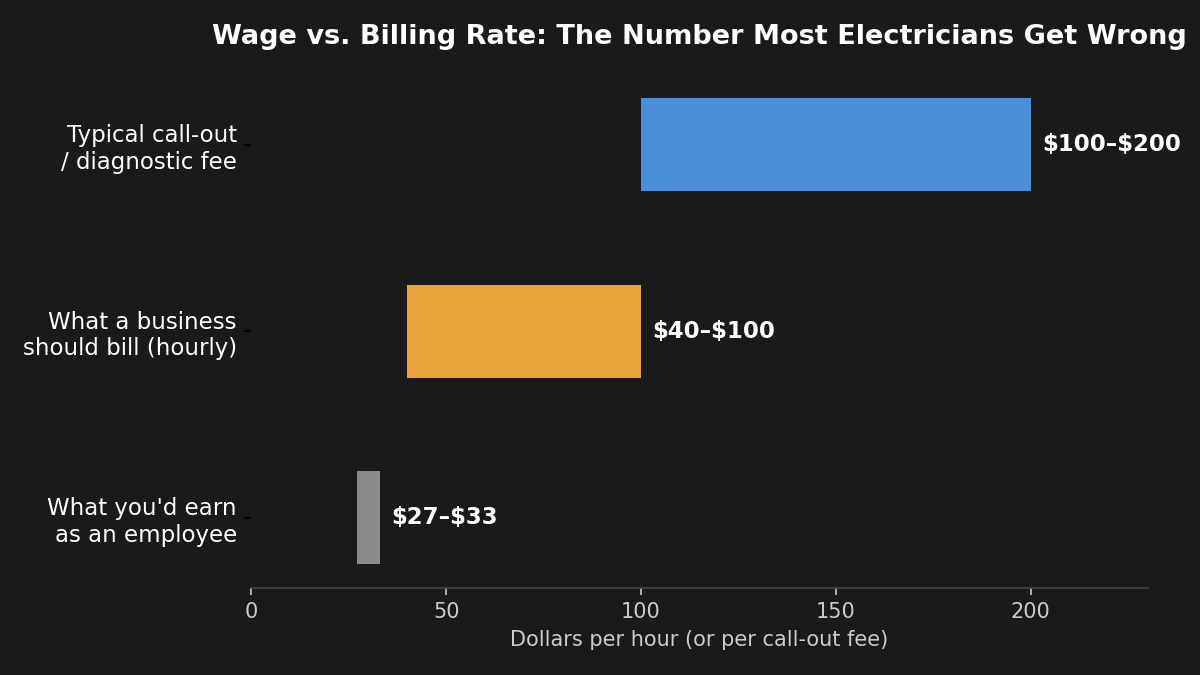
Search "how much do electricians make" and you’ll land on wage data. Electricians nationally average somewhere around $27 to $33 an hour as employees.[1] That number is real. It’s also not what your business should be charging. That’s what someone pays you to show up. Running the business costs more than just labor and materials. Truck payment and gas. Liability insurance. Tools that wear out. Bidding time, driving time, the hour you spend on the phone with a supplier who doesn’t have the part. None of that shows up in a wage number, and all of it has to be factored into your rate.
What the Market Actually Charges
According to Housecall Pro’s own 2026 pricing guide, electrical businesses that have this figured out are billing $40 to $100 an hour, depending on location, license level, and the type of work.[2] Most add a separate call-out or service fee on top, usually $100 to $200, specifically to cover the cost of just showing up before any work starts.[2] A lot of shops are also moving away from pure hourly pricing altogether, using flat rates for common jobs like outlet swaps or panel work and reserving hourly for diagnostics.[2]
What to Change
Start with your real overhead, not a guess. Add up truck, insurance, tools, and non-billable time for a month, then divide by the hours you actually bill. That’s your break-even, not your rate. Add your profit on top of that, not somewhere inside it. If you’re doing repeatable jobs, price a few of them flat instead of hourly. It protects you when a job runs long, and it’s easier for a customer to say yes to a number than a clock. Add a trip or diagnostic fee if you don’t already have one. It’s standard, not aggressive.
Know your real number
Skip the manual math. The Hourly Rate Calculator does this overhead-plus-profit math for you — plug in your numbers, get your rate.
Open the Break-Even Calculator →Bottom Line
If your rate is close to what you’d make as someone else’s employee, you’re not pricing a business. You’re pricing a job. Fix the number before you fix anything else.
Sources
- Compiled from PayScale, Indeed, and ZipRecruiter 2026 electrician wage data
- Housecall Pro: 2026 Electrician Pricing Guide, compiled from BLS, NECA, Angi, and HomeAdvisor data
Keep reading
Pricing & Estimating
How to Price a Landscaping Job Without Losing Money on It
Booked all week and still broke by the end of the month? The problem is upstream, in the number you write on the estimate.
Pricing & Estimating
Flat Rate Pricing for Plumbers: Build the Menu, Then Maintain It
You already run a profitable shop. Here's how flat rate pricing actually earns its keep, and where it quietly bleeds money over time.
Pricing & Estimating
Why You Keep Underpricing Jobs
And Don’t Realize It Until It’s Too Late